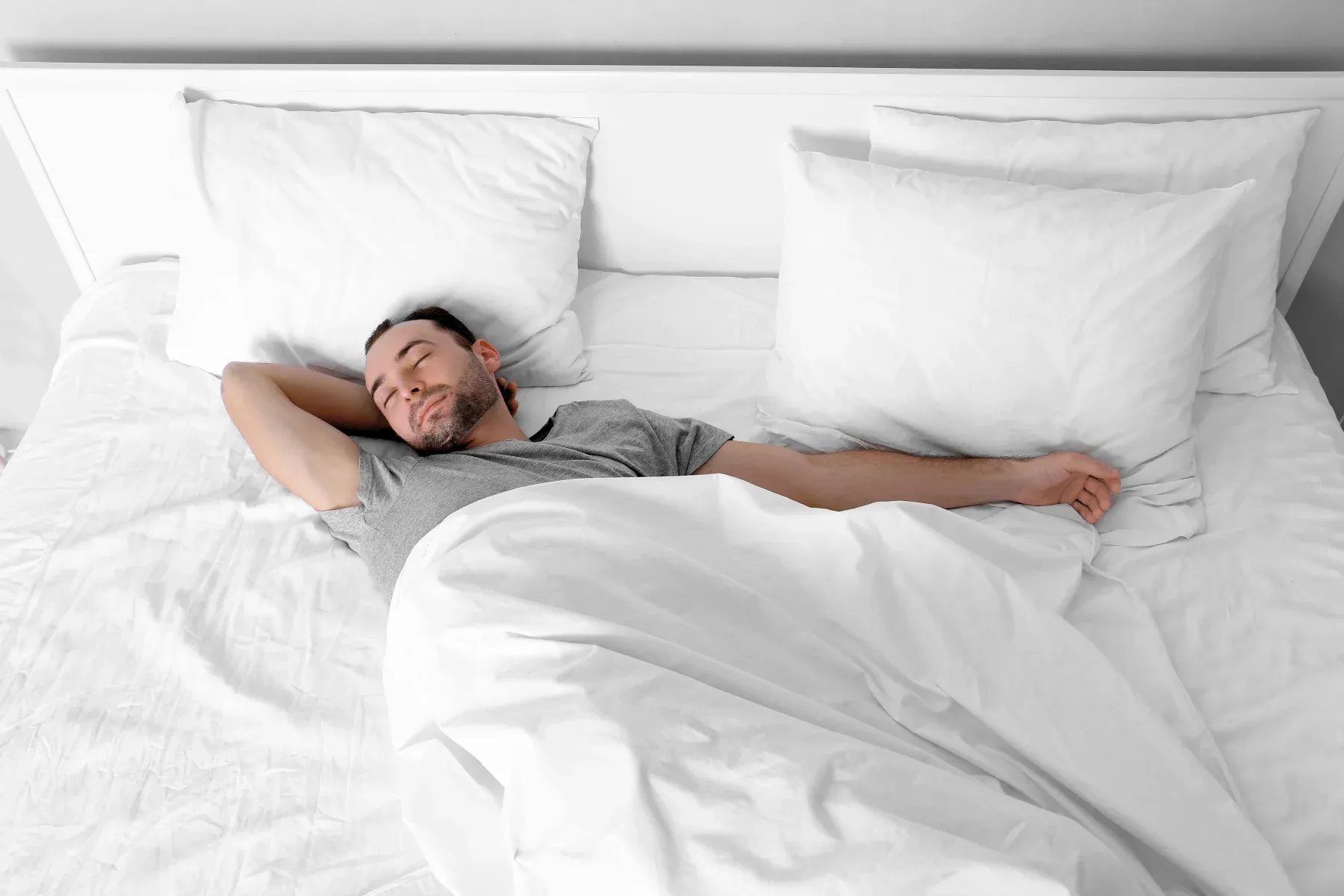

Key Takeaways
Waking up earlier is a skill, not a personality trait. These strategies make the shift stick.
- Shifting your alarm back by just 15 minutes every few days is enough to move your wake-up time without wrecking your sleep quality.
- A consistent sleep schedule, including weekends, keeps your circadian rhythm stable and makes early mornings feel less brutal over time.
- Your sleep environment matters as much as your bedtime. Temperature, light, and noise all affect how rested you feel when the alarm goes off.
- Morning light exposure in the first 30 minutes after waking is one of the fastest ways to reset your internal clock.
- Waking up early improves mental health, physical performance, and daily nutrition, but only if the sleep you're getting is actually good.
Those first few seconds after your alarm goes off are the real test. You're warm, your bed feels perfect, and every reasonable part of your brain is voting to stay put.
But waking up early is one of the highest-leverage habits you can build. More focus, better workouts, less chaos. The catch is that most people try to force it overnight and burn out by Thursday.
These 10 tips make the transition stick.
Adjust Your Wake-Up Time
Don't set your alarm for 5 AM tomorrow if you're currently waking up at 7:30. That's a fast track to exhaustion and abandoning the whole idea by day three.
Move your alarm back by 15 minutes every 2 to 3 days. Your body clock, called circadian rhythm, responds to incremental changes, not hard resets.
At this pace, you can shift your wake-up time by a full hour in about two weeks without the sleep deprivation that kills most early-morning experiments.
Wake Up Early and Refreshed
If you’re looking for a way to improve your sleep quality, then the Chilipad Dock Pro is the perfect solution. The cooling mattress pad uses advanced technology to regulate your body temperature while you sleep.
Keep a Consistent Sleep Schedule
Your internal clock runs on repetition. Going to bed and waking up at the same time every day, including weekends, is what keeps it accurate.
Weekend sleep-ins feel like a reward, but they throw your rhythm off enough to make Monday mornings significantly harder. Staying within 30 minutes of your usual wake time on Saturday and Sunday makes the rest of the week easier.
Schedule Tip: Eating dinner earlier can also help. A lighter, earlier meal makes it easier to fall asleep at your target time.

Build a Wind-Down Routine
Your brain needs a signal that the day is ending. Without one, you go from screen to pillow and wonder why you can't fall asleep.
Spend the last 30 to 60 minutes before bed doing something low-stimulation:
- Reading a physical book
- Listening to calm audio
- Light stretching
- Warm bath
The bath works especially well because the post-bath cooling effect mirrors the natural drop in core body temperature that happens as you fall asleep.
Screens are the main obstacle here. Blue light suppresses melatonin production, which delays sleep onset. Cut them out at least 30 minutes before bed.
Sleeping Tip: If cutting screens entirely isn't realistic, blue light glasses are a practical workaround that reduces melatonin disruption without requiring you to put your phone in another room.
Enhancing Your Sleep Environment
The right sleep environment makes it easier to fall asleep, stay asleep, and wake up feeling rested.
Keep your room dark. Melatonin production is sensitive to light, even low-level ambient light from street lamps or electronics. A sleep mask or blackout curtains make a real difference.
Keep it cool. Research consistently points to around 65 degrees Fahrenheit as the ideal sleep temperature for most people. [1] If your room runs hot, or your body does, that's where a temperature-controlled mattress pad earns its place.
Consider a noise machine if you're a light sleeper. Here are some popular choices:
They all work to mask disruptive sounds without being distracted.
Limit Caffeine Intake
Caffeine has a half-life of about 5 to 7 hours, meaning that half of what you drink at 3 PM is still in your system at 8 or 9 PM.
That's enough to delay sleep onset and cut into deep sleep stages even if you fall asleep on time. A systematic review published in Sleep Medicine Reviews found that caffeine intake later in the day consistently pushed back sleep onset, reduced total sleep time, and lowered overall sleep quality. [2]
The fix is straightforward: set a hard cutoff at 2 PM and stick to it.
Prepare the Night Before
Morning stress is one of the biggest reasons people hit snooze. When you wake up to a pile of unresolved decisions, the bed becomes very appealing.
Remove the friction the night before. Set out your clothes. Pack your bag. Prep your coffee. Decide what you're eating for breakfast.
Five minutes of prep the night before eliminates 20 minutes of groggy, disorganized scrambling in the morning.
Helpful Sleep Tip: If you're serious about getting up, put your alarm across the room. You physically have to get out of bed to turn it off.
Get Morning Light Immediately
Light is the most powerful signal your circadian rhythm receives. Getting outside or near a window within the first 15 to 30 minutes of waking signals to your brain that the day has started.
This sharpens alertness and makes it easier to fall asleep at your target time that night.
If natural light isn't available in the morning, a light therapy box is a practical alternative. The goal is bright light exposure early, not all day.
Give Yourself a Reason to Get Up
Willpower alone won't sustain an early alarm. Attaching something you actually want to your morning routine makes the habit self-reinforcing.
That could be a coffee ritual you enjoy, your favorite breakfast, a workout you look forward to, quiet time before the house wakes up, or a specific project you only work on in the morning.
Research on behavioral motivation supports this: linking a desired activity to a behavior increases your valuation of that behavior over time. [3]
Make the morning worth getting up for.
Use Naps Strategically
If you're building toward an earlier wake time and running a temporary sleep deficit, a short nap can help you function without wrecking your ability to fall asleep at night.
Keep naps to 10-20 minutes. Anything longer than 30 minutes risks sleep inertia, the heavy grogginess that comes from waking during a deeper sleep stage.
Nap before 3 PM. After that, naps start competing with nighttime sleep pressure.

Know What You're Getting Out of It
The habit sticks faster when you're clear about what it actually delivers.
Mental Health
People with later sleep and wake times report higher rates of anxiety and depression than those with earlier schedules. [4]
Early rising doesn't cure anything, but the combination of more morning light, more consistent sleep timing, and less reactive morning chaos has real effects on mood.
Physical Performance
Research shows that shifting sleep schedules earlier improves reaction time and overall physical output during morning hours. [5] If you train or compete in the morning, this matters.
Nutrition
Early risers consistently eat breakfast more often than late risers. Skipping breakfast is linked to lower daily diet quality and worse energy regulation throughout the day. [6] [7] Having time to eat a real breakfast is a bigger advantage than it sounds.
One More Variable Most People Ignore
Your tips, routine, and schedule can be dialed in perfectly and still not work if your sleep quality is off. Temperature is the most underrated factor.
Your core body temperature needs to drop by one to two degrees to initiate and maintain deep sleep. If you sleep hot, that drop is harder to achieve and harder to sustain.
The Chilipad keeps your bed at the exact temperature your body needs throughout the night, so you hit deeper sleep stages faster and wake up more rested, regardless of when your alarm is set.