
Key Takeaways
The House passed a bill to make daylight saving time permanent, but the Senate has not voted, so clocks are still set to fall back on November 1.
- The House passed the Sunshine Protection Act 308 to 117 on July 14, 2026. The Senate has not scheduled a vote.
- Senators from both parties worry about dark winter mornings, and the Senate left on October 5 without a vote and doesn’t return until November 9, after the clocks change.
- Congress tried permanent daylight saving time in 1974. Support fell from 79% to 42% in about two months, and it was repealed that fall.
- Major sleep groups, including the American Academy of Sleep Medicine, and Chilipad's own sleep experts back permanent standard time instead.
- A 10 p.m. bedtime works either way. Shift by 12 minutes a night for five nights, get morning light, and keep your bed cool.
Short Answer
The House passed a bill to make daylight saving time permanent in July 2026, but the Senate has not voted. Clocks are still set to fall back on November 1. Sleep experts back permanent standard time over permanent daylight saving time, and a steady bedtime works either way.
Daylight saving time is not going anywhere yet. The House passed a bill in July to make it permanent, but the Senate has not voted, so most clocks are still set to fall back on Sunday, November 1. [1] [2]
If that has you confused, you are in good company. Congress has been arguing about the clock for years, and the whole thing has the energy of a thermostat war between two people who both refuse to blink.
This post covers where the bill stands, why the last try at permanent daylight saving time flopped, why sleep experts prefer standard time, and a simple plan to get to bed by 10 p.m. no matter what happens.
What Is Going On With Daylight Saving Time?
The House passed the Sunshine Protection Act on July 14, 2026, by a vote of 308 to 117, and the bill is now waiting in the Senate. [1] [3]
It would make daylight saving time the permanent, year round time for most of the country. States could still pass a law to stay on standard time, which is what Hawaii and most of Arizona do today. [4]
This is not the first try. The Senate passed a similar bill without a single objection in 2022, and then it stalled in the House. [1] Now the two chambers have swapped roles, which is Congress's way of keeping things fresh.
Why Is the Senate Stuck on the Clock Bill?
The Senate is stuck because some senators worry about dark winter mornings, and the calendar is running out. Sen. Tom Cotton of Arkansas has warned that the change would push winter sunrises to an absurdly late hour and send kids to school in the dark. [1]
Senate Majority Leader John Thune said he voted against similar legislation in committee because of late winter sunrises in South Dakota. [4]
The pushback is bipartisan, and one senior aide called it a geographic issue, not a partisan one. [5] In the House, 22 Republicans and 95 Democrats voted no. [1]
In the Senate, Democratic Sens. Amy Klobuchar of Minnesota, Tammy Duckworth of Illinois, and Gary Peters of Michigan were among those who previously voted against it in committee. [5]
President Trump has urged the Senate to vote as soon as possible, but no vote was held. [2] [4] The Senate left town on October 5 without voting and does not return until November 9, which is after the clocks change. [2]
Even a bill with strong House support needs floor time, and floor time is hard to find. [2] Without every senator agreeing to speed things along, the bill would likely need 60 votes to move forward. [6]
Translation for the sleepy is that the clocks are very likely falling back on schedule.
Has the U.S. Tried Permanent Daylight Saving Time Before?
Yes, and it did not go well. Congress passed year-round daylight saving time in December 1973 to save energy during the oil crisis, and it began in January 1974. [7]
Public support fell from 79% in December to 42% in February, largely because people were suddenly commuting and walking to school in the dark. [7]
Congress repealed it in the fall of 1974, and President Gerald Ford signed the repeal on October 5, less than a year after it started. [7] It was supposed to run for two years, and NPR reported it did not cut energy use either. [8]
Americans loved the idea of no clock changes right up until they met a January sunrise at 9 a.m. in parts of the country. [7]
What Do Sleep Experts Say About Permanent Daylight Saving Time?
Sleep experts say permanent standard time is the better choice, and Chilipad's sleep expert, Ana Marie Schick, agrees.
The American Academy of Sleep Medicine backs it because it lines up best with human circadian biology. [9] In plain terms, standard time keeps your body clock in sync with the rising and setting of the sun. [9]
The National Sleep Foundation, the Sleep Research Society, and the American Medical Association have taken similar positions. [9]
Fans of permanent daylight saving time love brighter evenings for exercise, family time, and life after work, and that is a fair point. The sleep science just points toward mornings.
Everyone agrees the twice-a-year switch is the troublemaker. [1] [9] The real debate is which time to lock in.
Your Bed Temperature Is the One Thing You Can Control
The clocks may change, but your sleep environment does not have to. Chilipad keeps your mattress at the exact temperature your body needs to fall asleep and stay there all night.
What Is the Best Bedtime Plan If the Clocks Still Fall Back?
Keep the same evening countdown, no matter what the clocks do.
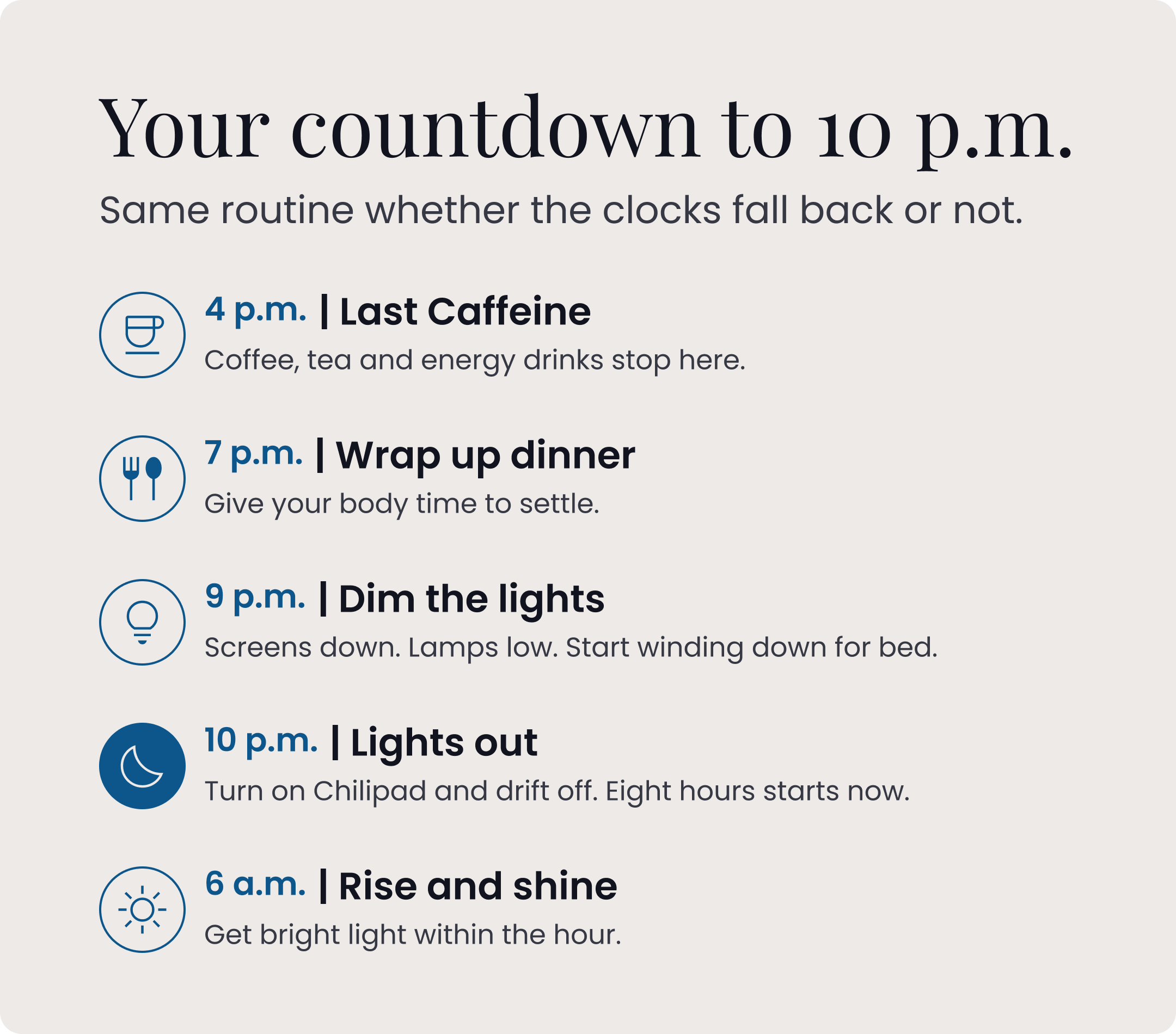
Most people find fall back easier than spring forward. Staying up a little later comes naturally. Waking up earlier doesn’t. This shift also lands you on standard time, the one sleep experts prefer. [9]
Falling back also hands you a free hour. Here’s how to make the most of it.
- Give it to sleep. Stick to your new bedtime and let the extra hour go to sleep, not another episode.
- Get outside early on Sunday. Bright morning light helps your body clock settle into the new time faster.
- Keep naps short. A quick nap is fine. A long one can make Sunday night’s bedtime harder.
Want to ease into it instead of jumping straight to the 10 p.m. on Sunday? The 4-day sleep reset walks through a slower, night-by-night shift.
Can a Cooler Bed Help No Matter What Congress Does?
Yes, a cooler bed may help you fall asleep and stay asleep whether the clocks change or not. Great sleep is not random. It is temperature, and cooler nights make better days.
A 2026 Loughborough University study found that cooling the mattress improved sleep satisfaction by 57%. [11]
Chilipad uses water to chill or warm your mattress anywhere from 55 to 115°F, so your bed stays steady even when the calendar does not.
Chilipad 2.0 can start cooling at bedtime and finish with Warm Awake, a gentle warm up that may help you wake naturally, which is handy when the sun has not clocked in yet. It fits the mattress you already own, and there is no subscription.
Congress can argue about the clock, but your bed temperature is entirely up to you. Couples who fight over temperature can set two zones, so each side of the bed keeps its own temperature.
The Bottom Line
Daylight saving time is stuck in the Senate, and the clocks are very likely to fall back on November 1. Sleep experts, including Chilipad's own, would rather see standard time permanent.
Whatever Congress decides, a steady bedtime, morning light, and a cool bed do more for your sleep than any time zone debate.
Congress may not agree on what time it is, but you can still agree on 10 p.m.
Daylight Saving Time FAQs
Did the Daylight Saving Time Bill Pass the Senate?
Will the Clocks Still Fall Back on November 1, 2026?
What Happened the Last Time the U.S. Tried Permanent Daylight Saving Time?
Do Sleep Doctors Prefer Permanent Daylight Saving Time or Standard Time?
What Time Should I Go to Bed When the Clocks Change?
Disclaimer: This blog is for informational purposes only and is not a substitute for professional medical advice, diagnosis, or treatment. Always talk to your healthcare provider about your symptoms, conditions, or treatment options.