Key Takeaways
Body temperature rises as early as week four of pregnancy, peaks in the first trimester, and follows a predictable pattern through each trimester that directly affects sleep quality.
- Body temperature spikes in the first trimester and peaks early in pregnancy.
- The second trimester brings some relief, but skin temperature runs hot in the back, thighs, and lower body.
- By the third trimester, most women prefer a sleep environment roughly 3 to 4 degrees cooler than before pregnancy.
- Temperature dysregulation continues postpartum for up to three months after birth.
- Controlling your bed surface temperature, not just the room, is the most direct way to address these changes at every phase.
Short Answer
Pregnancy raises body temperature from as early as week four. It peaks in the first trimester, shifts to surface heat in the second, then causes the most sleep disruption in the third, even as core temperature begins to come down. The changes continue for up to three months postpartum. At every stage, cooling the bed surface directly produces better results than cooling the room.
Your body runs hotter the moment you get pregnant. Most women find out the hard way, somewhere around 2 AM, kicking off blankets and staring at the ceiling.
But here's what most women don't know. Pregnancy doesn't raise your body temperature the same way every week. It shifts, spikes, and drops in patterns that track closely with each trimester.
Your sleep gets caught in the crossfire of all those changes. Understanding how pregnancy sleep temperature shifts week by week is the first step to actually doing something about it.
Pregnancy sleep temperature by trimester follows a pattern your body is already running. Here's what each phase actually looks like.
Why Pregnancy Makes You Run Hot
No mystery here. Your body is working overtime.
From the moment of conception, progesterone surges and blood volume starts climbing. Your metabolic rate increases to support fetal development. Your cardiovascular system speeds up.
All of that extra physiological activity generates heat, and your body pushes it outward.
Research tracking more than 10,000 pregnancies via wearable data found that temperature changes become detectable as early as week four of pregnancy, peak at roughly 0.5ºF above pre-pregnancy baseline around week nine, and then decline gradually toward birth. [1]
That's not a subtle shift. That's your body doing a full thermal reset before most people even have their first ultrasound.
The problem is that your bed was made for the person you were before any of this started. It has no idea what trimester you're in.
Your Bed Should Work as Hard as Your Body Does
You don't need your mattress to track your pregnancy. The Chilipad 2.0 keeps you cool from week one through postpartum. No modes, no subscription, no thermostat wars. Just set your temperature and sleep.
First Trimester (Weeks 1-13)
The first trimester is the hottest and most disruptive phase. Core body temperature is at its highest point of the entire pregnancy during the first trimester. Sleep quality gets disrupted fastest here.
Large-scale wearable data shows that first trimester pregnancies are characterized by more time in bed, about 30 minutes more, and more time awake, about 15 minutes more, compared to pre-pregnancy baselines. [2]
Here are more details on the differences between fitness trackers and mattresses.
You're exhausted, but you're not actually sleeping well. You're lying there, hot and restless at night, while your body processes one of the most significant biological events of your life.
Night sweats and overheating are common in the first trimester even before there's a visible belly. This catches a lot of people off guard. You expect to feel the heat in the third trimester. You don't expect it at six weeks.
Nausea compounds everything. It is harder to fall asleep when you feel sick. It's harder to stay asleep when you're running hot. And it's harder to get comfortable in any position when your body feels completely unfamiliar.
The most effective fix at this stage is cooling the bed surface directly, not just the room. Your partner may feel perfectly comfortable at the same temperature.
That does not mean you are. Dual-zone temperature control means you can run your side as cool as you need without turning the bedroom into a refrigerator.
Second Trimester (Weeks 14-27)
The heat does not let up in the second trimester even though energy returns and nausea fades. Sleep quality stabilizes for most women but the thermal load shifts rather than disappears.
The heat doesn't go with it.
Research using thermal imaging found that the most significant increases in skin surface temperature during pregnancy occur in the second trimester, particularly in the upper and lower back and thighs. [3]
These are exactly the areas making contact with your mattress while you sleep.
This is also the trimester when most women shift to side sleeping. That positional change matters for heat distribution.
More contact means more heat retention, more sweating, and more disrupted sleep, especially in the second half of the night when your body temperature naturally rises.
Back discomfort starts showing up in the second trimester. It's hard to address position-related pain when you're also running hot. The two problems stack. Here are a few tips on how to sleep with back pain.
What helps? Consistent cooling on both sides of the bed helps most here, especially as your sleep position changes and your body runs warmer in the areas making the most contact with the mattress.
Pregnancy Sleep Tip: Most healthcare providers recommend sleeping on your left side during pregnancy. This position supports circulation and reduces pressure on major blood vessels.
Third Trimester (Weeks 28-40)
The third trimester is where sleep takes its biggest hit. Core body temperature begins to come down but sleep disruption reaches its peak.
Core body temperature actually begins to come down in the third trimester, but sleep quality hits its lowest point. By the time of birth, time in bed peaks while sleep duration drops to its minimum, with nighttime wakefulness registering more than three standard deviations above pre-pregnancy baseline. [4]
That's a scientific way of saying you're up a lot.
Data from thousands of pregnancies show that by the third trimester, women consistently set their sleep environment roughly 3ºF cooler than before pregnancy. [5] That preference doesn't come from nowhere. Your body is telling you exactly what it needs.
Frequent bathroom trips, difficulty finding a comfortable position, and a sharp increase in nighttime wake events all converge in these final weeks.
You can't control the wake-ups caused by a full bladder or a well-timed kick. But you can control what you come back to when you try to fall back asleep.
What actually helps is precise, consistent cooling that stays where you set it all night. Not a fan of cycling on and off.
Not cooling sheets that stop working after an hour. The Chilipad 2.0 holds steady at the temperature your body wants, no matter what's happening outside the window.
Do you rely on a fan to sleep at night? Find out if sleeping with a fan is bad for you.
Postpartum: The Temperature Problem Doesn't Stop at Delivery
Nobody talks about this part enough.
Research confirms that maternal core body temperature regulation is altered for at least three months following birth. [6]
The hormonal swings of the postpartum period, compounded by breastfeeding, night feeds, and a sleep schedule that no longer resembles anything predictable, keep your body's temperature regulation out of sync well beyond delivery.
Data shows that sleep temperature preferences return to near pre-pregnancy baseline around eight weeks postpartum. [7]
That means for roughly two months after giving birth, your body is still running warmer than it was before you got pregnant, even while you're also getting up every two to three hours for a newborn.
This is arguably the moment when temperature-controlled sleep matters most. It is also the moment when most people have the least energy, time, or bandwidth to deal with anything extra. The last thing you need is a system that requires management.
What Actually Fixes It?
Managing pregnancy sleep temperature isn't about blasting the AC. A few things get recommended a lot that don't address the actual problem.
- Bedroom Fans: Cool the air in the room, not the surface your body is in contact with all night. That helps a little. It doesn't help enough when you're running 3 degrees above your pre-pregnancy baseline.
- Cooling sheets: They are a reasonable short-term fix. They're passive. Once they reach your body temperature, they stop doing anything. No active cooling, no consistency, and no ability to adjust when you wake up at 3 AM overheated.
- Turning down the thermostat: It works until your partner or anyone else in the house notices. Thermostat wars are real. They're more real when one person is pregnant and one person is not.
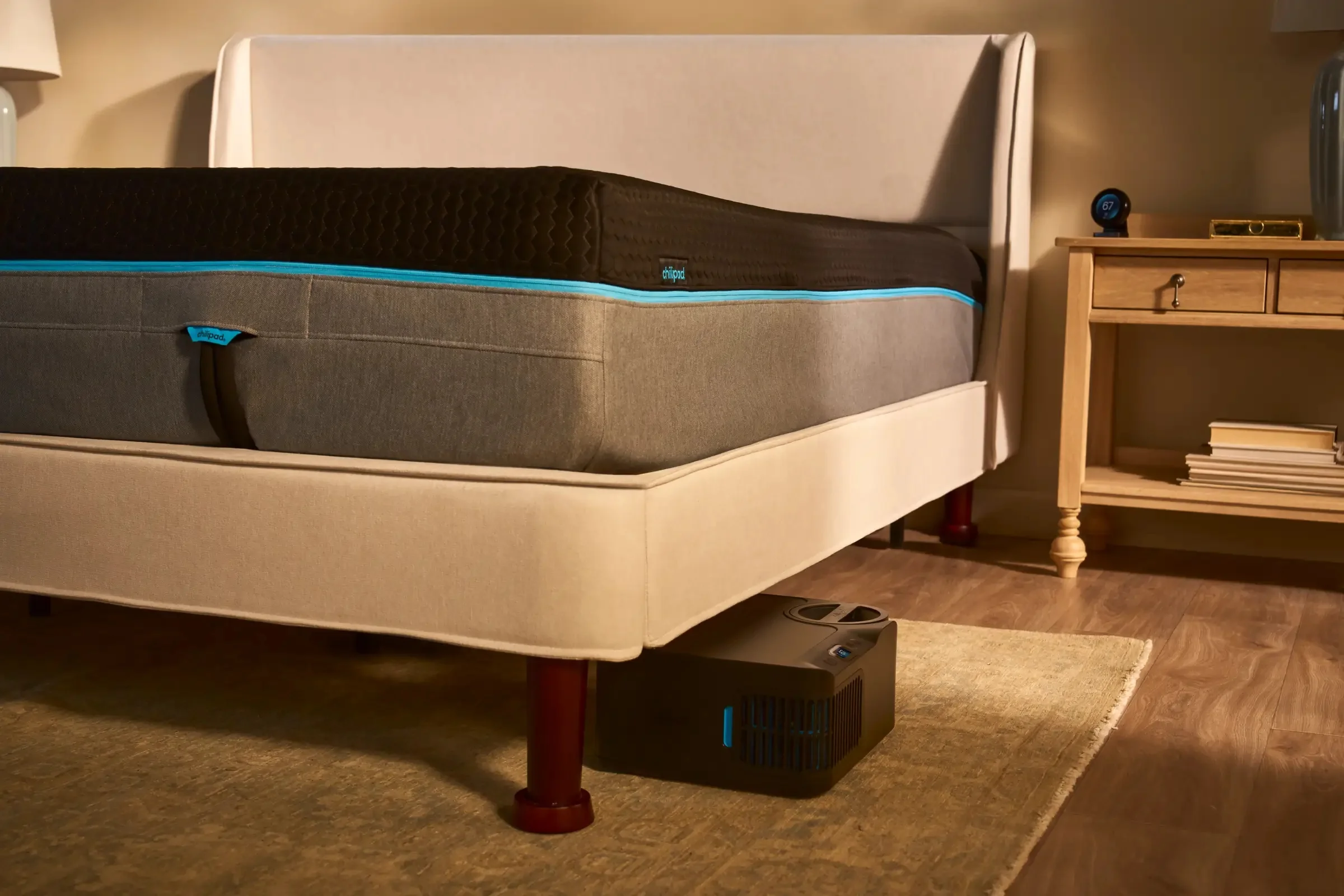
The Chilipad 2.0 is built for exactly this:
- Cools at the bed surface, where your body temperature actually matters.
- Water runs through the Hydrolayer all night, holding the exact temperatures you set.
- Dual zones mean your side can be set at 62 degrees while your partner stays at 74 degrees.
- No subscription, no modes to activate.
- Set your temperature, go to sleep.
The Hydrolayer slides out completely for washing, because pregnancy and postpartum are messy enough without adding "how do I clean this" to the list.
The Bottom Line
Pregnancy sleep temperature by trimester is not random. Your body follows a predictable thermal pattern from week four through postpartum, and your sleep follows with it
You can't change biology. You can change what you sleep on. A bed that maintains the temperature your body asks for at each stage of pregnancy and into the postpartum period is not a luxury.
For most pregnant women, it's the difference between sleeping and lying awake at 2 AM.
Sleep Temperature During Pregnancy Frequently Asked Questions
How Does Body Temperature Change During Pregnancy?
Why Do Pregnant Women Sleep So Hot?
What Is the Best Pregnancy Sleep Temperature?
How Long After Giving Birth Does Body Temperature Return to Normal?
Does a Cooling Mattress Pad Help With Pregnancy Night Sweats?
Disclaimer: This blog is for informational purposes only and is not a substitute for professional medical advice, diagnosis, or treatment. Always talk to your healthcare provider about your symptoms, conditions, or treatment options.